
Search 16 local agent histories. Resume supported sessions. Track Codex and Claude quota burn.
macOS · Open Source · Local-first
Search local conversations from Codex, Claude Code, Cursor, and 13 other coding agents in one Mac app. Read the transcript, find supported image outputs, and resume supported CLI sessions.
For every agent: open Session Info; for Codex and Claude, see which sessions are burning through your quota.
brew install --cask jazzyalex/agent-sessions/agent-sessions
Search 16 local agent histories. Resume supported sessions. Track Codex and Claude quota burn.
Sixteen active agent formats and legacy Droid sessions, side by side and labelled with the surface they came from. Search and browsing work across every source; resume and image support depend on the source and installed CLI version.
| Agent | Surfaces | Resume | Quota Meter |
|---|---|---|---|
| Codex | Desktop · CLI · VS Code | Yes | 5h · weekly · $/h |
| Claude | Desktop · CLI | Yes | 5h · weekly · $/h |
| Cursor | Agents Window · CLI | Yes | — |
| Antigravity | CLI | Yes | — |
| GitHub Copilot | CLI | Yes | — |
| OpenCode | CLI | Yes | — |
| Pi | CLI | Yes | — |
| Hermes | CLI | Yes | — |
| Kimi Code | CLI | Yes | — |
| Grok CLI | CLI | Yes | — |
| Qwen Codenew in 5.0 | CLI | Yes | — |
| OpenClaw | CLI | — | — |
| Devin CLI | CLI | Active sessions | — |
| fx | CLI | Command tested | — |
| Clinenew in 5.4 | Desktop · CLI | — | — |
| DeepSeek Harnessnew in 5.5 | CLI | — | — |
| Droidlegacy | CLI | — | — |
| Add your agent → | Thirteen files, each with a test |
The Quota Meter reads Codex and Claude usage windows — the other agents don't publish a quota to meter. Every agent above is searchable, browsable, counted in Analytics, and has a Session Info surface with source-appropriate detail.
Apple Notes-style search across all agents and within a single session. Inline image support and an Image Browser for visual output from Codex, Claude, and OpenCode.
Right-click a supported CLI session to copy the exact resume command, or open it directly in Terminal.app, iTerm2, or Warp.
Manage archived sessions — delete, reveal, and diagnose with archive status tooltips.
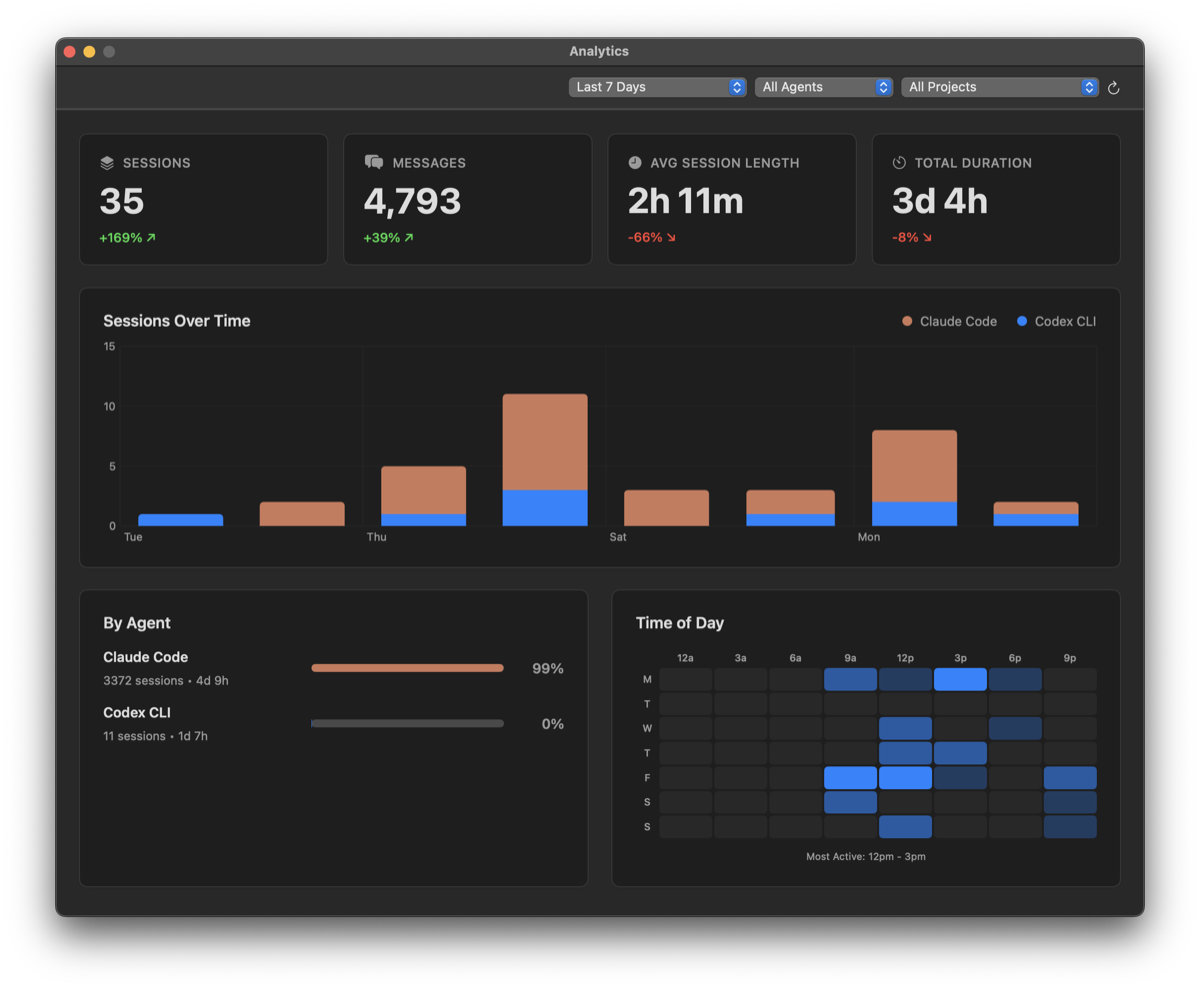
Flip cards with sparklines: session trends, agent breakdowns, time-of-day heatmaps.
How fast each session burns your plan — and how much you have left. Quota Meter reads your Codex and Claude 5-hour and weekly limits alongside active-session burn, so one glance shows which sessions use your quota and when each limit resets. Three ways to keep it in view:
$ lens rates each model in a session separately, so an Opus orchestrator driving Sonnet subagents is costed at what each actually runs at rather than blended into one number.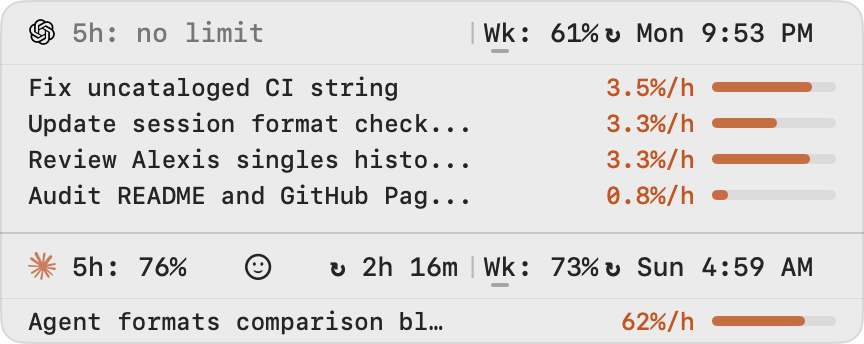
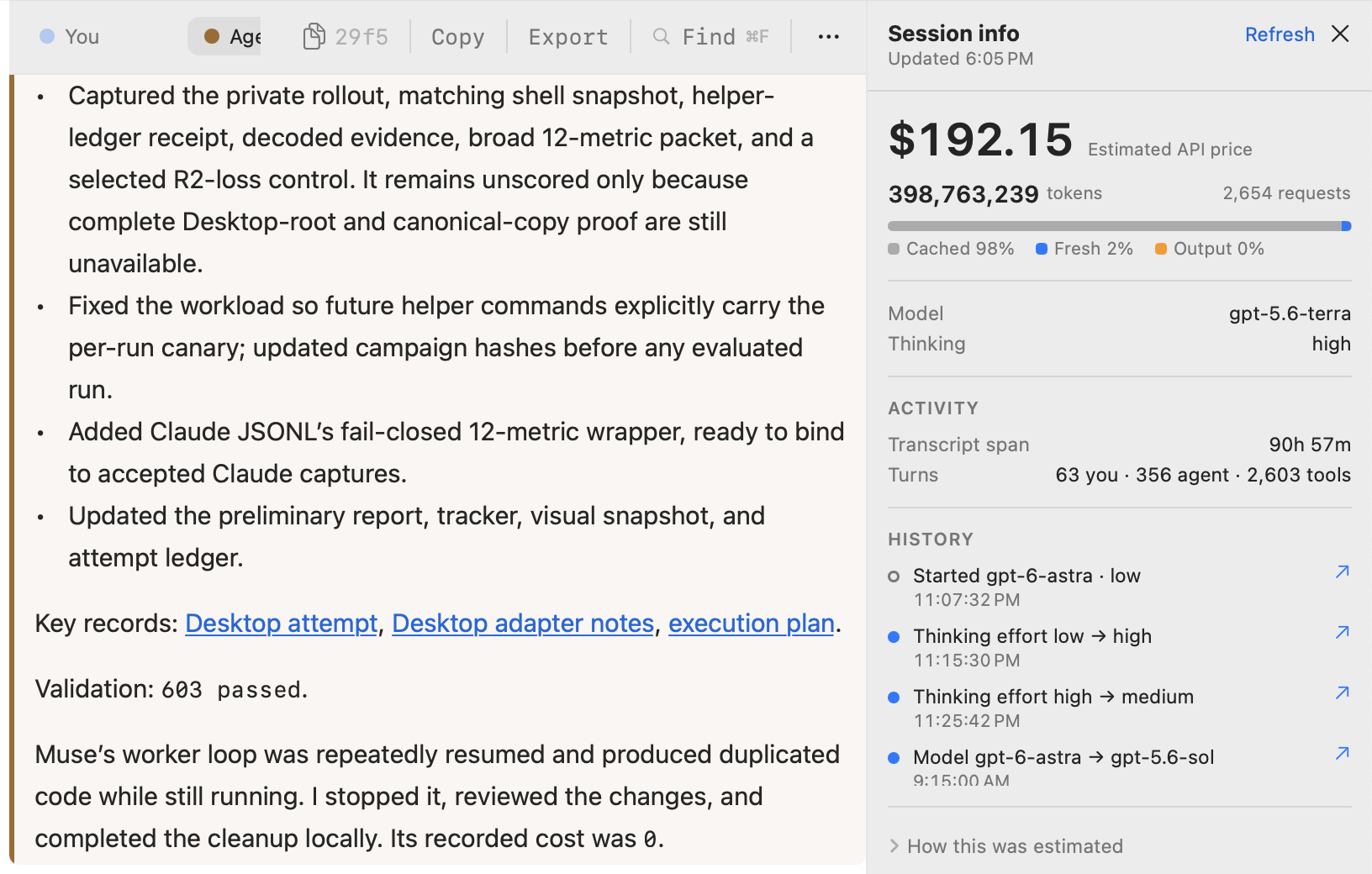
What a supported agent session recorded, beside its transcript. Press ⇧⌘I and the panel starts with quick info for every source, then reads the session's own records when detailed telemetry is available:
The price is an estimate, not your plan bill.
Make it searchable, then return to the work that matters.
Sessions search with transcript and image preview

Saved Sessions with restore actions

Image Browser for visual session outputs

Menu bar status strip

Analytics dashboard filtered to one project
Where each agent keeps its sessions, what Agent Sessions reads, and where the boundaries are.
How CLI, Desktop, and VS Code rollout history is read from ~/.codex/sessions.
Where OpenCode stores session data and how to browse old runs locally.
What Claude Code writes to local transcripts and where the boundary is.
How Cursor Agent transcripts are read from Cursor's local storage.
How Hermes sessions in ~/.hermes/state.db become searchable history.
How OpenClaw JSONL sessions are discovered, searched, and kept separate.
Where Copilot writes events.jsonl, and why its own SQLite store is not the transcript.
Two stores under ~/.gemini, and the sibling file that holds the untruncated text.